How to Microdose Shrooms: A Beginner’s Guide
Instead of completely altering one’s state of mind, microdosing offers the subtle benefits of improved mental acuity and mood without causing any major shifts in consciousness. Microdosing is like taking vitamins or drinking green tea, essentially a daily health supplement for the mind.
If you are new to microdosing shrooms, this guide covers everything you need to know to get started!
What Is Microdosing?
Microdosing is the practice of consuming an unnoticeable to barely noticeable amount of a psychedelic substance, such as psilocybin or LSD, on a structured, routine schedule. Microdosing psilocybin mushrooms (also called “shrooms”) is done by taking a fraction of a regular recreational or therapeutic dose.
While a single recreational dose might approach or surpass 1.5 to 3.5 grams of dried mushrooms, a microdose sits between 0.05 and 0.25 grams of dried mushrooms. In such a microscopic dosage range, the psychoactive substances affect your neurochemistry in ways you cannot consciously observe. Notably, you retain full capacity to perform tasks, engage in conversation, operate motor vehicles and machinery, manage responsibilities and obligations and go about daily activities.
Microdosing Checklist: Make Sure You’re Safe With Your Shrooms!
Now, psilocybin is certainly one of the safest drugs out there and it may be among the least addictive natural medicines.
Still, that does not mean it is without risks.
So, let’s review the microdosing shroom checklist to help ensure your first experience goes smoothly assuming your state permits it.
First of All, Check the Law!
Psilocybin‘s legality varies wildly around the world:
- USA: Federally listed as Schedule I, but legally prescribed for therapy purposes in states including Colorado and Oregon, along with decriminalization measures enacted in cities across America, including Seattle and Washington, D.C.
- Canada: Classified under Schedule III, but medically exempted for clinical purposes. Also decriminalized for personal possession in regions such as British Columbia via special pilot projects.
- International: Legal in nations including Jamaica and Holland, but severely restricted elsewhere.
Make sure you understand your area’s regulations!
Avoid Microdosing if
Microdosing isn’t for everyone. Avoid it if you:
- Have a personal or family history of psychosis (e.g., schizophrenia, bipolar disorder).
- Are pregnant or breastfeeding due to lack of safety data.
- Have severe heart issues – consult a doctor first.
- Are under 21; it’s for adults only.
Watch Out for Possible Medication Interaction!
| Drug Class | Common Examples | Interaction Level |
| SSRIs / SNRIs | Lexapro, Zoloft, Prozac, Effexor, Cymbalta | Moderate blunting effect |
| MAOIs | Nardil, Parnate, Marplan | Potentially dangerous amplification |
| Lithium | Prescription lithium carbonate | HIGH RISK: Seizure potential |
If you’re on medications like SSRIs, SNRIs, or MAOIs, be cautious. These can interact with psilocybin in significant ways.
- SSRIs (Selective Serotonin Reuptake Inhibitors) and SNRIs: Common antidepressants like Lexapro, Zoloft, Prozac, or Effexor bind to the same serotonin receptors as psilocin. They act like a sponge, occupying those receptor sites. As a result, SSRIs usually attenuate or blunt the effects of psilocybin. You will not experience a dangerous toxic reaction, but you may find that microdosing yields little to no noticeable benefit. Never stop taking prescribed SSRIs cold turkey to microdose; always consult your physician.
- MAOIs (Monoamine Oxidase Inhibitors): Found in older antidepressants and certain botanical preparations (like Ayahuasca vine), MAOIs block the enzyme that breaks down psilocin. This can dramatically amplify the potency of your dose by 2x to 3x, turning a safe microdose into an unexpectedly intense psychedelic experience. Exercise extreme caution.
- Lithium: DO NOT combine psilocybin with prescription lithium. Clinical reports indicate that combining lithium with psychedelics creates a severe risk of seizures, extreme confusion, and medical emergencies.
Set Your Intentions
In psychedelic assisted therapy, experts frequently speak of “Set and Setting.”
- Set (Mindset): Your internal state – your thoughts, mood, expectations, and emotional baggage going into the experience.
- Setting (Environment): Your physical surroundings, social context, and immediate environment.
Though Set and Setting primarily applies to full doses of psychedelics, it applies equally well to microdoses – perhaps even better. Avoid microdosing on the same day as a job interview, crazy traffic schedule, confrontation or other highly stressful event. Pick a less intense day where your schedule remains free.
Instead, choose an easygoing day, particularly a nice morning on the weekend, before taking a microdose. Establish an intention ahead of time.
Intention: Something you’d like to grow or foster that day – patience, concentration, compassion, inspiration, etc. Document your intention in your journal.
Step-by-Step: How To Microdose Magic Mushrooms

It’s cheap, easy, and totally controllable when you microdose magic mushrooms – right from the comfort of your house. By doing things yourself, you can rest assured that cleanliness and consistency will follow every dose along the way.
Step 1: Procure Some Mushrooms and Decide Which Strain
First thing’s first: Get some dried mushrooms and become familiar with the specific strain you’ve acquired.
While there are many Psilocybe species used in microdosing practices, Psilocybe cubensis accounts for the vast majority of doses worldwide. There are plenty of subvarieties within the cubensis category.
Here are a few strains of Psilocybe cubensis worth considering:
| Strain Name | Relative Potency | Ideal for Beginners? |
| Golden Teacher | Moderate / Standard | YES – Top Choice |
| B+ (Be Positive) | Moderate / Standard | YES – Very Consistent |
| Cambodians | Mild to Moderate | YES – Gentle Profile |
| Mazatapec | Moderate | YES – Smooth & Balanced |
| Penis Envy (PE) | High (2× Standard) | NO – Reduce dose by 50% |
| Albino Penis Envy (APE) | Very High (2×–3×) | NO – Microdose at ~0.03 g |
– Golden Teacher: With its moderate strength, this strain is among the favorites for microdosers. The effects produced are generally considered enjoyable, producing an overall well-rounded high.
– B+ (Be Positive): Similar to Golden Teachers, this variety of cubensis is reliable in its effects and potency levels.
– Cambodians: These mushrooms offer mild strengths, and so can easily be enjoyed by beginners.
– Mazatapec: Yet another strain featuring moderate strengths, Mazatapec produces a smooth and enjoyable microdosing session for novice users.
– Penis Envy (PE) and Albino Penis Envy (APE): On the higher end of the potency spectrum, both strains demand reduced dosages for microdosing purposes to prevent a potent experience.
Should you receive a batch of dried mushrooms that still feel a tad moist or spongy upon delivery, you can remedy the issue yourself. Simply put your mushroom stash inside a sealed glass jar, complete with a few packets of silica gel, for two full days.
Commercial products like mushroom chocolates and gummies have become popular, but buyer beware! Many of these products don’t contain real mushrooms and may include synthetic chemicals. For the safest experience, it’s best to work directly with whole dried mushrooms that you can prepare yourself.
Step 2: Grinding for Uniformity and Homogeneity
Ready for some fun! Powdering your mushrooms ensures consistent dosing at each session, so we’re getting into the main event.
A major thing to remember here is how widely potency levels will fluctuate between individual specimens within a harvest. Even a single cap may contain significantly higher amounts of psilocybin than a section cut from the surrounding stalk. These variations create an extremely unreliable experience when consuming pieces as-is.
By grinding your mushrooms down into a homogeneous powder, we mix these inconsistencies evenly, balancing out each session’s dose.
How do you go about this?
- Weigh out 5 to 10 grams of completely dried mushrooms.
- Break them into smaller pieces.
- Put these pieces in a clean electric coffee or spice grinder.
- Grind in short bursts for about 30 to 45 seconds.
- Let the powder settle for a couple of minutes before opening the grinder to prevent a dust cloud.
When done, place your powder into an amber or glass jar containing silica gel packs to absorb excess moisture. Securely seal your container in a cool, dry location where it can last up to one and a half years or more.
Step 3: Calculating and Measuring Your Starting Dose
Now that you’ve ground up those mushrooms, how much should you really ingest? It’s worth remembering once again: Start low and go slow. Each person processes psilocybin mushrooms uniquely; therefore, a dose that is nearly undetectable for another may pack quite the wallop for you personally. If you choose to ingest your dosage, ensure you’ve chosen the right day without responsibilities.
Dosing Chart
Here’s a handy dosing guide for your microdosing endeavors:
| Dose Category | Weight Range (g) | Physical & Conscious Effects |
| Low Microdose | 0.02–0.05 g | Sub-perceptual. Highly subtle. Ideal for sensitive individuals. |
| Sweet Spot Microdose | 0.08–0.15 g | Classic microdose zone. Sub-perceptual boost in mood, focus, energy. |
| High Microdose | 0.16–0.25 g | Upper limit. Bordering on light perceptual sensations. |
| Mini-Dose / Museum Dose | 0.30–0.75 g | Mild perceptual zone. Light body high, color enhancement, spacey. |
Step 4: Easy Ways to Consume Your Microdose
There are several straightforward and enjoyable methods to take your microdose. Pick the one that suits your lifestyle and preferences!
Option A: The Capsule Method (Best for Convenience and Taste)
One of the easiest and most popular ways to microdose is by using capsules. These can hide the strong taste of the mushrooms and help you make doses that are consistent.
Capsule Size Guide:
– Size #1: Holds about 0.10 to 0.15 grams (great for beginners)
– Size #0: Holds about 0.15 to 0.25 grams (standard microdose)
– Size #00: Holds about 0.30 to 0.50 grams (for higher doses)
Why Choose Capsules?
Capsules help mask the earthy flavor of the mushrooms, protect the powder from oxygen, and let you prepare multiple doses at once.
How to Make Shroom Capsules:
- Purchase a cheap manual capsule filling tray online alongside empty “Size 0” or “Size 1” capsules.
- Place your empty capsule bottoms into the filling board.
- Pour your measured batch of homogenized powder across the top of the board, using the included scraper card to sweep the powder evenly into the capsule openings.
- Use the tamping tool to gently press the powder down.
- Snap the top caps into place until you hear them click shut.
- Store your finished capsules inside your airtight glass Mason jar with a silica desiccant packet!
Option B: The Raw Powder Method (Direct or Mixed into Food)
If buying capsules isn’t an option for you, you can take the powder directly.
– Direct Method: Place your 0.10 gram of powder directly on your tongue and wash it down with water, juice, or herbal tea.
– Food Mixing: Stir your measured amount into your smoothie, oatmeal, or a spoonful of peanut butter, yogurt, or applesauce.
Tip: Avoid adding the powdered mushrooms to anything too hot, like boiling soup or baked goods, as high temperatures can break down the active compounds.
Option C: Microdose Tea Infusion (Gentle on the Stomach)
If you have a sensitive stomach or frequently experience mild digestive fluttering after consuming raw fungal fiber, brewing a quick microdose tea is a fantastic, stomach-soothing alternative.
Instructions:
- Measure your mushroom powder and put it in a ceramic mug.
- Add a bag of ginger or peppermint tea to help with digestion.
- Pour 6 to 8 ounces of hot water (not boiling) into the mug.
- Stir and let it steep for about 10 to 12 minutes.
- If you’d like, strain the mixture to remove any powder sediment.
- Sweeten with honey and add a little lemon juice. Sip it slowly!
Option D: Stamets Stack Microdosing (With Niacin and Lion’s Mane)
Invented by the famous mycologist Paul Stamets himself, the Stamets Stack is one of many neurohack methods designed to maximize neuroplasticity, cognitive function enhancement and creation of additional neuron paths.
Components & Effects:
– Psilocybin Powder: 0.05 to 0.10 grams (for neuroplasticity)
– Lion’s Mane Extract: 500 to 1,000 mg (stimulates nerve growth)
– Niacin (Vitamin B3): 25 to 50 mg (helps open blood vessels)
According to Stamets, Niacin acts as an aid for delivery of the compounds to nerve endings. There’s something important to note regarding the niacin component, which I’ll get to shortly.
Note on Niacin Flush: Make sure to use real Nicotinic Acid, not “flush-free” niacin. Within 15-20 minutes of taking niacin, you will experience a warm, red, itching sensation across your skin (the “niacin flush”). Dont freak out – this is completely harmless, normal, and lasts about 30 minutes!
Step 5: Choosing the Right Microdosing Protocol
You should never microdose every single day! If you take psilocybin daily, your brain rapidly undergoes receptor downregulation (tolerance building). By day four, you will feel zero benefits, wasting your valuable material.
To maintain neurochemical sensitivity, structure your journey using one of these proven schedules.
The Fadiman Protocol (1 Day On, 2 Days Off)
Created by Dr. James Fadiman, author of The Psychedelic Explorer’s Guide, this is the undisputed gold standard protocol for beginners.
- Day 1 (Microdose Day): Take your microdose with breakfast. Observe your mood, focus, and energy.
- Day 2 (Transition/Afterglow Day): Psilocybin is capable of promoting neuroplasticity well past its initial consumption time, and this process takes two days to complete itself before reaching equilibrium again. During these days, expect mild residual positive side effects known as “afterglows.”
- Day 3 (Normal/Reset Day): Take no dose! Your brain flushes its system, completely resetting serotonin receptor sensitivity back to baseline.
- Day 4 (Microdose Day): Take your next microdose and repeat the cycle!
The Stamets Protocol (4 Days On, 3 Days Off)
Designed specifically to work alongside the Stamets Stack (Niacin + Lion’s Mane).
- Schedule: Microdose for 4 consecutive days (e.g., Monday through Thursday), followed by 3 consecutive days off (e.g., Friday through Sunday).
- Best For: Creatives, students and other professionals looking to achieve peak cognitive function for intensive periods of mental work during the weekday before fully resetting their systems over the weekend.
Every Other Day Protocol (1 Day On, 1 Day Off)
- Schedule: Alternating every single day (On, Off, On, Off).
- Best For: Experienced microdosers managing persistent low mood or fatigue who need more frequent support. Note: Tolerance can build slightly faster on this schedule, requiring a two-week break every month.
Intuitive or Fixed Day Protocol (e.g., Workday Schedule)
- Fixed Days: Setting fixed schedule days, such as dosing every Tuesday and Thursday morning.
- Intuitive: Microdosing only when you feel an authentic internal need – such as before a high-focus creative project, an intense brainstorming day, or a deep wilderness hike.
Comparison Chart: Which Schedule Fits Your Lifestyle?
| Protocol Name | Weekly Frequency | Best For | Tolerance Risk |
| Fadiman Protocol | 2 to 3 Days/Week | Beginners / All | Extremely Low |
| Stamets Protocol | 4 Days On, 3 Off | Workweek Focus | Low to Medium |
| Every Other Day | 3 to 4 Days/Week | Short-Term Boost | Medium |
| Fixed (Tue / Thu) | 2 Days/Week | Busy Professionals | Very Low |
Step 6: Keeping Track, Journaling, and Fine-Tuning Your Experience
Microdosing requires self-awareness. Keeping a journal helps identify your ideal dosage.
Why Journal? Memory can be biased and susceptible to the placebo effect. A journal captures subtle positive changes, like improved mood or reduced fatigue.
Daily Metrics to Record: Use a notebook to log your mood, focus, energy, and sleep on a 1-10 scale each evening.
Journal Entry Template:
- Date: __________
- Time Taken: __________ AM
- Dose Weight: __________ g
- Protocol Day: ☐ Microdose ☐ Afterglow ☐ Rest
Metric Ratings (1-10):
- Overall Mood: _____ / 10
- Focus: _____ / 10
- Energy: _____ / 10
- Social Calmness: _____ / 10
- Sleep Quality: _____ / 10
Observations:
- Did I feel any perceptual edge? (Y/N) _____
- Notable moments of flow or creativity: __________
- Additional notes: __________
Adjusting Your Dosage: Review your entries every two weeks:
- If feeling jittery or anxious, reduce dose by 0.02g.
- If no improvements after 3 days, increase dose by 0.02g.
- If feeling balanced and clear, you’ve found your Sweet Spot- lock that dose in!
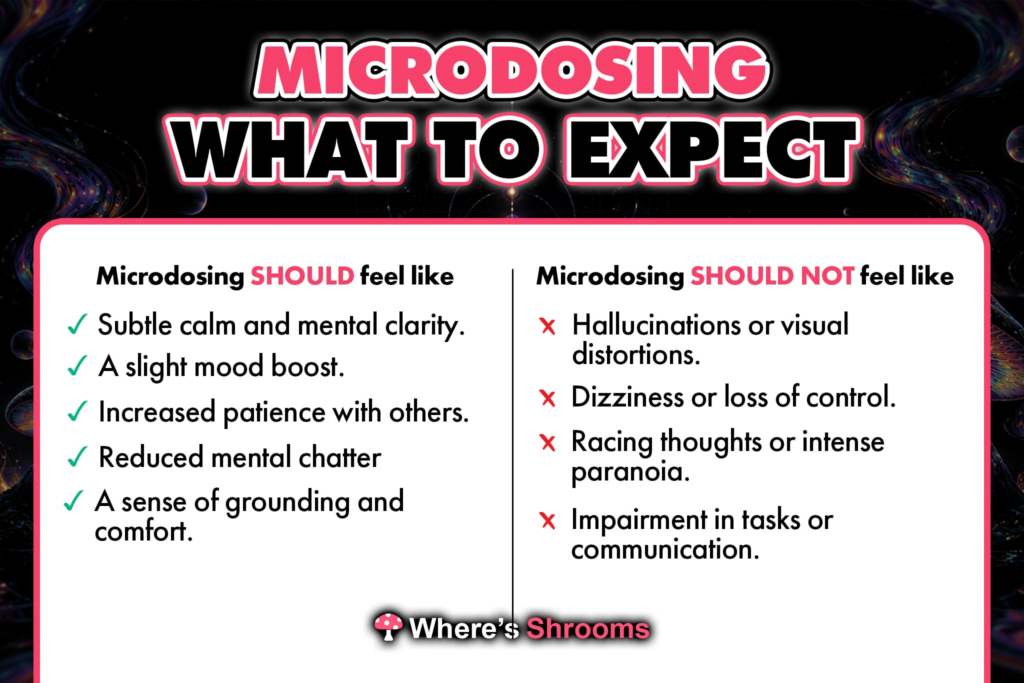
Microdosing is inherently associated with psychedelics like mushrooms, which means newbies often approach microdosing with some unfounded fear of spiraling into chaos. So, let’s address this topic directly by covering everything you might feel.
What a microdose should NOT feel like:
- You should not see hallucinations, visual distortions, geometric patterns, or altered colors.
- You should not feel dizzy, disoriented, or out of control.
- You should not experience racing thoughts, intense paranoia, or emotional overwhelm.
- You should not feel impaired while operating machinery, working, or communicating.
What a true microdose SHOULD feel like:
- A subtle, background sense of calm and mental clarity.
- A slight lifting of your general mood, like a bright sunny day after a week of clouds.
- A bit more patience with family, co-workers, or tedious daily tasks.
- A gentle reduction in the “mental chatter” or self-critical inner monologue.
- A feeling of being grounded, physically comfortable, and present in your body.
If you notice walls wiggling, colors blooming, or your mind wandering into deep philosophical rabbit holes during your workday, you have taken a “mini-dose” rather than a microdose. Do not panic! You are completely safe, but it simply means you will want to scale back your measurement next time.
Why Do People Microdose? Key Benefits and Expectations
With plenty of users preferring microdosing over shrooms to escape this world, the microdosers themselves have several motives beyond mere recreation. A couple significant advantages of microdosing include:
- Flow State and Focus: many users mention their improved ability to slip into flow mode – that incredible state wherein time disappears as work becomes sheer enjoyment.
- Emotions and Mood: Microdosing often acts as the gentlest form of mood lifter, dulling any spikes of everyday worries, nervousness, minor depression and anxiety without numbing emotions altogether. The lack of emotional disconnection makes microdosing quite different from conventional pharmaceutical antidepressants and anti-anxiety drugs, which often cause a loss of affect or indifference toward feelings.
- Creative Boost and Inspiration: By fostering divergent thought patterns, microdosing helps users break free of thought traps and creatively connect concepts to inspire solutions to challenging tasks.
- Increased Vigor: Plenty of folks note a natural surge in energy without jitters – making microdosing popular among those who need something stronger than their caffeine-fueled drinks to keep going. Again, this advantage differs significantly from shrooms’ impact on the body.
- Socialization and Empathy: When it quiets the inner critic, microdosing allows users to converse more easily, enjoying more fulfilling conversations in the process.
Integrating Microdosing into Your Life for Lasting Change

Microdosing can be a great tool for personal growth, but it’s important to remember that it isn’t a quick fix. Think of it as wearing floaties while learning to swim. They help keep you afloat, but you still need to paddle and kick to move across the water.
Similary Psilocybin helps loosen up rigid thinking patterns and gives your brain a chance to form new connections, but it’s up to you to decide how to use that opportunity.
To really benefit from microdosing, consider combining it with practices that support your overall well-being. For instance mindfulness, breathwork, and meditation can be much easier on microdosing days since it quiets the mind and helps you focus. Ten minutes of simple breathing or mindfulness practice can feel more achievable, helping you find a state of calm.
You can also boost the benefits of microdosing by incorporating exercise and healthy eating. Engaging in aerobic activities like running, swimming, or cycling while microdosing can enhance brain health further. Taking nature walks can help you feel more connected to the world around you, and eating whole, nutritious foods can keep you feeling clear-headed.
Remember, microdosing isn’t something you should do every day forever. It’s meant to be a structured practice. After about six to eight weeks of microdosing, take a four-week break to evaluate how you’re doing without it. You might be surprised to find that the good habits you picked up during that time stick with you, helping you maintain your mood and focus on your own.
Essential Terminology: Key Concepts Made Simple
To help you navigate the world of microdosing with confidence, let us break down some specialized terms. Whenever you encounter technical vocabulary in this guide, refer to this section for clear, plain-English definitions.
- Psilocybin (SIGH-low-SIGH-bin): The naturally occurring, non-psychoactive prodrug found in over 200 species of fungi.
- Lay-friendly definition: Think of psilocybin as the “raw material” inside the mushroom. By itself, it does not directly cause psychedelic effects; your body must process it first.
- Psilocin (SIGH-low-sin): The actual psychoactive compound produced when your liver digests psilocybin.
- Lay-friendly definition: This is the active molecule that binds to your brain cells to boost neuroplasticity, elevate mood, and alter perception.
- Sub-Perceptual Threshold: The operational zone where a substance produces biological and psychological benefits without altering your conscious perception or sensory experience.
- Lay-friendly definition: The “sweet spot” dose where the mushroom works quietly in the background without making you feel high, tripped out, or intoxicated.
- Receptor Downregulation: A biological process where your brain cells temporarily reduce their sensitivity or available receptor count in response to frequent stimulation.
- Lay-friendly definition: The physical mechanism behind buildable tolerance. If you take shrooms every day, your brain hides its “locks” so the “key” (psilocin) stops working.
- The Entourage Effect: The synergistic interaction of multiple natural compounds working together within a biological organism.
- Lay-friendly definition: The idea that whole, real mushrooms contain various trace alkaloid compounds (like baeocystin and norbaeocystin) that work together to produce a smoother, richer benefit than pure, isolated chemical extracts.
- Homogenization: The mechanical process of thoroughly blending a substance so that every portion has an identical, uniform distribution of ingredients.
- Lay-friendly definition: Grinding multiple dried mushrooms into a single fine powder so every dose has the exact same potency from day to day.
To give you a clear bird’s-eye view of how doses differ, let us examine how a microdose compares to larger therapeutic or recreational quantities:
- Microdose (0.05g – 0.25g): Fully sub-perceptual. You remain completely functional, alert, and sober while enjoying background mood enhancement and mental focus.
- Macrodose (1.0g – 3.5g): Fully perceptual. Produces classical psychedelic effects, including vivid visual alterations, emotional release, altered time perception, and deep introspective insights. Requires a dedicated day, safe environment, and a sober sitter.
- Heroic Dose (5.0g+): Extremely intense and profound. Leads to a complete temporary dissolution of your sense of self (“ego death”), total detachment from daily reality, and deep sensory immersion. Reserved for experienced journeyers in controlled settings.